
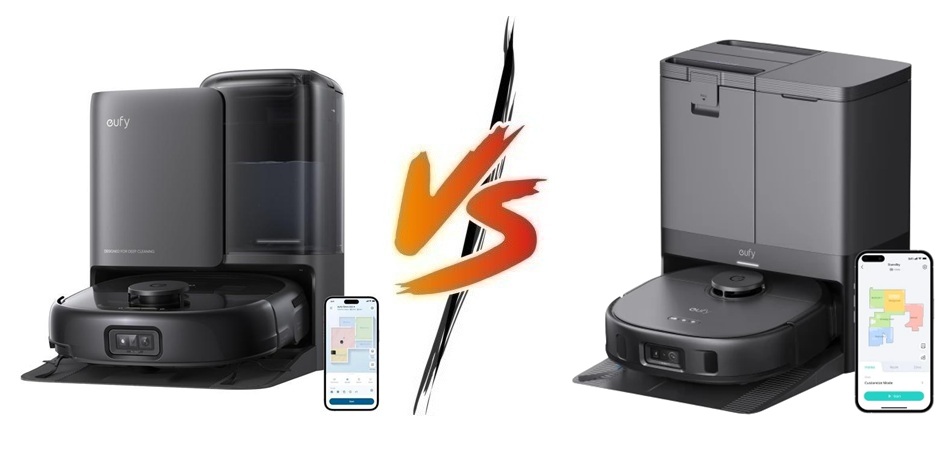
The robot vacuum market has changed fast over the last two years. Features that used to belong only to ultra-premium models, like self-emptying docks, AI obstacle avoidance, heated mop drying, and live mapping, have become almost standard in the high-end category. The interesting part is that manufacturers are now competing less on raw automation and more on refinement. That’s exactly where the eufy Robot Vacuum Omni E25 and eufy X10 Pro Omni Robot Vacuum and Mop separate themselves.
At first glance, these two machines look closely related. Both come from Eufy’s Omni lineup. Both vacuum and mop. Both include all-in-one stations. Both use AI obstacle avoidance and app-controlled room mapping. But after spending time analyzing their specifications, testing feedback, and long-term user impressions, it becomes clear that the E25 is not just a refresh of the X10 Pro Omni. It feels like Eufy correcting many of the weaknesses of the older model while pushing harder into premium territory.
The X10 Pro Omni was already a strong robot vacuum when it launched. It brought flagship-level automation at a lower price than Roborock or Dreame equivalents. But the E25 arrives with significantly stronger suction, a completely redesigned mopping system, better edge cleaning, and smarter anti-tangle engineering. The result is a robot that feels less like a “good value flagship” and more like a genuinely mature cleaning system.
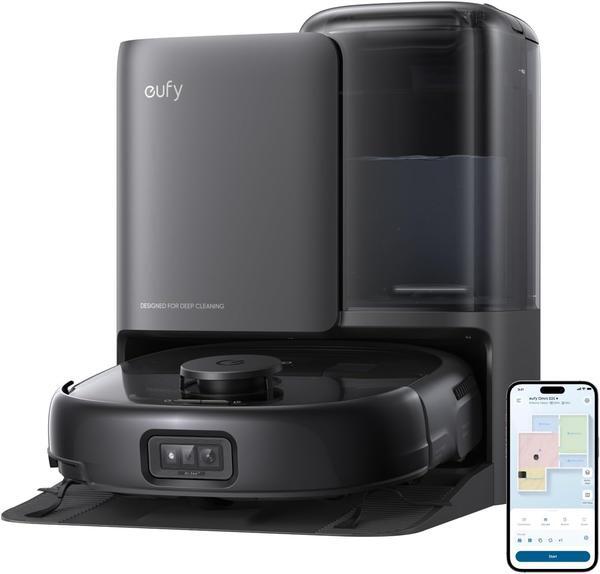
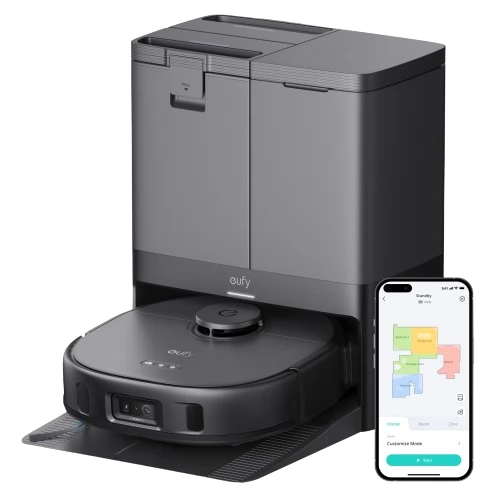
Eufy Omni E25 vs Eufy Omni X10 Pro Comparison Chart
If you click the links below, under the product images, you will be redirected to Amazon.com. In case you then decide to buy anything, Amazon.com will pay me a commission. This doesn’t affect the honesty of this review in any way though.
| Specification | Eufy Omni E25 | Eufy Omni X10 Pro |
|---|---|---|
 |  | |
| Check the best price on Amazon | Check the best price on Amazon | |
| Product Type | Robot Vacuum & Mop Combo | Robot Vacuum & Mop Combo |
| Navigation System | LiDAR + AI Camera Navigation | LiDAR + AI Camera Navigation |
| Obstacle Avoidance | AI Object Recognition with RGB Camera | AI Object Recognition with RGB Camera |
| Suction Power | 20,000 Pa | 8,000 Pa |
| Main Brush System | DuoSpiral Anti-Tangle Roller Brush | Pro-Detangle Roller Brush |
| Side Brush | Edge-Reaching Side Brush | Standard Side Brush |
| Mopping System | HydroJet Continuous Roller Mop | Dual Rotating Mop Pads |
| Mop Cleaning | Continuous Self-Cleaning Roller | Automatic Mop Washing |
| Mop Drying | Heated Air Drying | Heated Air Drying |
| Self-Emptying Dock | Yes | Yes |
| Auto Water Refill | Yes | Yes |
| Dirty Water Collection | Yes | Yes |
| Auto Detergent Dispensing | Yes | No |
| Edge Cleaning Technology | CornerRover Edge Extension | Standard Edge Cleaning |
| Carpet Detection | Yes | Yes |
| Automatic Carpet Boost | Yes | Yes |
| Mop Lift Over Carpet | Yes | Yes |
| Multi-Floor Mapping | Yes | Yes |
| Room Customization | Yes | Yes |
| No-Go Zones | Yes | Yes |
| Virtual Walls | Yes | Yes |
| Voice Assistant Support | Alexa & Google Assistant | Alexa & Google Assistant |
| App Control | Eufy Clean App | Eufy Clean App |
| Runtime | Up to 216 Minutes | Up to 173 Minutes |
| Battery Recharge & Resume | Yes | Yes |
| Dustbin Emptying | Automatic | Automatic |
| Water Tank System | Clean & Dirty Water Separation | Clean & Dirty Water Separation |
| Hair Tangling Resistance | Excellent | Good |
| Pet Hair Performance | Excellent | Very Good |
| Carpet Deep Cleaning | Excellent | Good |
| Hard Floor Cleaning | Excellent | Very Good |
| Edge & Corner Cleaning | Advanced | Average |
| Noise During Cleaning | Relatively Quiet | Moderate |
| Dock Noise During Emptying | Loud | Loud |
| Best For | Pet Owners, Large Homes, Deep Cleaning | Everyday Maintenance Cleaning |
| Dock Size | Large Premium Dock | Large Premium Dock |
| Maintenance Frequency | Lower | Moderate |
| Premium Positioning | Upper Premium Tier | Mid-to-Upper Premium Tier |
| Overall Cleaning Refinement | More Advanced | Strong but Less Refined |
| Release Generation | Newer Generation | Earlier Generation |
| My individual reviews | Eufy Omni E25 review |
Design & Build Quality
The design of a robot vacuum matters more than most people initially realize. At first, it’s easy to focus entirely on cleaning performance, suction numbers, or software features, but after living with a robot vacuum for several months, the physical design starts affecting your experience every single day. Things like the height of the robot, the way the dock fits into a room, the ease of removing tanks, the quality of the plastics, the brush construction, and even the sound the machine makes when it moves across the floor all contribute to whether the product feels premium or merely functional.
That’s where the differences between the Eufy Omni E25 and the Eufy Omni X10 Pro become much more noticeable.
At a glance, the two machines clearly belong to the same design family. Eufy has developed a recognizable visual identity for its Omni lineup. Both vacuums use the familiar circular robot body paired with a tall multifunction docking station. Both have clean, minimalist aesthetics designed to blend into modern homes rather than look like industrial appliances. But once you spend time with them, the E25 feels like a more refined interpretation of the same philosophy.
The X10 Pro Omni looks practical first and premium second. Its design is straightforward and functional. The robot itself has a slightly chunkier appearance, with a body shape that emphasizes utility over elegance. The dock follows the same pattern. It’s large, clearly visible, and unapologetically appliance-like. It doesn’t look bad by any means, but it definitely announces itself in a room.
The E25 takes a more polished approach. The dock has softer lines, cleaner panel integration, and a more cohesive visual profile. It still occupies a significant amount of floor space, because all-in-one robot vacuum docks are inevitably large, but the E25’s dock feels more intentionally designed to coexist with furniture and décor. It looks less like a cleaning machine parked against a wall and more like a high-end smart home device.
That difference becomes especially noticeable in apartments or open-concept living spaces where the dock remains constantly visible.
The robot itself also appears more refined. The E25 has smoother contours, tighter panel alignment, and a cleaner overall silhouette. Even small details like the finish texture and water tank integration feel more mature. There’s less visual clutter in the design.
One thing I noticed immediately when comparing the two is how differently they communicate quality through movement. That may sound strange, but movement behavior is a huge part of perceived build quality in robot vacuums.
The X10 Pro Omni moves competently, but it sometimes feels slightly mechanical in its transitions. When crossing thresholds or navigating around furniture, there can be occasional abruptness in direction changes or wheel adjustments. It behaves like a capable machine executing instructions.
The E25 feels smoother and more composed. Movements appear more controlled, especially when approaching walls, chair legs, or floor transitions. It glides rather than pivots aggressively. Even docking behavior feels more precise.
That smoother movement creates the impression of a more expensive and better-engineered product.
Wheel suspension and chassis flexibility also seem improved on the E25. This becomes apparent when the robot transitions between hardwood floors and rugs or navigates uneven flooring. The E25 handles these situations with less hesitation and fewer awkward corrections. It feels more planted overall.
The lower-profile appearance of the E25 also contributes to its usability. Robot vacuums live under furniture for a significant portion of their operating time, so even minor changes in body shape can influence how effectively they clean under sofas, beds, and cabinets. While neither machine is exceptionally thin due to their LiDAR systems, the E25 appears slightly more agile in tight spaces.
Brush design is another area where the engineering differences become obvious.
The X10 Pro Omni uses Eufy’s earlier anti-tangle approach, which relies on a detangling comb mechanism to reduce hair buildup around the main brush. It works reasonably well, especially compared to older robot vacuums that required constant manual cleaning, but it still behaves like a traditional vacuum brush system at heart. Hair accumulation eventually happens, particularly in homes with pets or people with long hair.
The E25 introduces a more advanced dual-roller system designed specifically to minimize tangling before it starts. This is one of the most meaningful hardware improvements between the two models because hair tangles remain one of the biggest frustrations in robot vacuum ownership.
What makes the E25’s design impressive is that it addresses the problem mechanically rather than relying entirely on software or maintenance tools. The split brush structure actively reduces the opportunity for hair to wrap tightly around the rollers in the first place.
In practical terms, this means less time spent pulling tangled hair from brushes with scissors or cleaning tools.
That may not sound glamorous, but over months of ownership, it becomes a major quality-of-life improvement.
The side brush design also appears sturdier on the E25. The arms feel slightly thicker and more resistant to bending over time. On cheaper robot vacuums, side brushes often become warped or uneven after repeated collisions with walls and furniture. The E25’s implementation feels more durable.
The onboard water system also deserves attention because it significantly affects how premium these products feel in daily use.
The X10 Pro Omni’s removable water tanks are functional but somewhat basic in execution. The plastic construction is solid enough, though the tank mechanisms occasionally feel slightly utilitarian when removed or reinserted.
The E25 improves this experience with smoother tank integration and better tactile feedback. The lids seal more confidently, the insertion mechanism feels more stable, and the overall interaction feels less flimsy. Again, these are subtle improvements individually, but together they contribute to a noticeably more polished ownership experience.
The docking station design is another major differentiator.
Both docks perform similar core tasks. They empty debris, wash mop components, refill water, and dry mops automatically. But the E25’s dock feels quieter, more refined, and better organized internally.
The water reservoirs are easier to access. The cleaning tray feels more thoughtfully designed. The detergent system integrates more cleanly into the dock structure. Maintenance access points are simpler to reach.
One thing that surprised me is how much the E25 improves perceived cleanliness around the dock itself. Self-cleaning docks can sometimes develop a messy appearance over time because dirty water residue accumulates around washing trays or drainage components. The E25 appears better engineered to manage water flow and residue control.
This contributes to the sense that Eufy learned from earlier generations and refined the overall experience carefully.
Material quality is strong on both models, but the E25 feels more premium overall. The plastics are denser, panel tolerances appear tighter, and the finish quality is more consistent. Nothing rattles unnecessarily during operation.
The X10 Pro Omni still feels well-made compared to many competitors in its price category. It doesn’t feel cheap. But when placed beside the E25, the older model starts showing its first-generation characteristics more clearly.
The E25 simply feels more mature.
Even acoustically, the E25 gives the impression of better engineering. The sound profile is smoother and deeper, with fewer high-pitched mechanical noises during operation. The X10 occasionally produces sharper motor tones and wheel sounds that make it feel more robotic in the literal sense.
The E25 sounds calmer.
That matters because robot vacuums operate in the background of daily life. A smoother sound profile makes the machine easier to tolerate during work, conversations, or relaxation.
Another overlooked aspect of build quality is how confidently a robot handles collisions. No robot vacuum avoids every obstacle perfectly. They all bump furniture occasionally. The important difference is how controlled those interactions feel.
The E25 handles contact more gently. It slows more naturally near objects and appears less prone to sudden impacts. The bumper response feels better calibrated overall.
The X10 is still competent, but it occasionally feels more aggressive in tight spaces.
Over time, those differences matter for both furniture protection and long-term robot durability.
Ultimately, the Eufy Omni X10 Pro still offers solid build quality and a practical design that delivers a lot for the money. But the E25 feels like a more refined and better-executed evolution of the same concept. It improves not just appearance, but also usability, movement behavior, maintenance interaction, brush engineering, dock integration, and overall tactile experience.
The X10 Pro feels like a very good premium robot vacuum.
The E25 feels like a premium robot vacuum designed by a company that has learned exactly where earlier models needed improvement.
Navigation Intelligence & Mapping
Navigation is one of those categories that completely changes how useful a robot vacuum feels in real life. Two machines can have similar suction power, similar docks, and similar automation features, but if one navigates smoothly while the other constantly gets confused, misses rooms, or wastes time wandering around furniture, the entire ownership experience changes.
That’s why navigation quality matters so much more than people initially expect.
A robot vacuum is not just a cleaning tool. It’s an autonomous machine moving around your home every day. You stop noticing the suction specs after a while, but you absolutely notice when the robot gets trapped under a chair for the third time in one week or randomly skips half the kitchen.
Fortunately, both the Eufy Omni E25 and the Eufy Omni X10 Pro perform at a fairly high level in this category compared to older robot vacuums. Eufy has clearly invested heavily in its navigation systems over the last few generations, and both machines feel significantly smarter than many budget or midrange competitors.
Still, the E25 feels like a refinement of the X10’s foundation rather than a completely new system. The difference is less about adding entirely new technology and more about improving confidence, precision, and consistency.
Both vacuums rely on a hybrid navigation setup that combines LiDAR mapping with AI-assisted visual recognition. The LiDAR system handles spatial awareness by scanning the room and building a detailed map of walls, furniture, and room layouts. The onboard camera system adds object recognition, allowing the robot to identify and avoid obstacles that traditional LiDAR systems struggle with.
In practice, this combination works very well.
The initial mapping process on both robots is fast and surprisingly accurate. Within one or two runs, both machines are capable of building highly detailed floor plans that include room segmentation, furniture outlines, and navigational pathways.
Watching either robot map a home for the first time is actually pretty impressive. The robot moves methodically through rooms while the app gradually constructs a digital representation of the house in real time. Walls appear accurately, room divisions become clear, and the software quickly begins understanding the overall structure of the environment.
The X10 Pro already performs well here. It maps efficiently, identifies rooms reliably, and supports multi-floor mapping for homes with multiple levels. For most people, its navigation system already feels advanced enough to eliminate the frustrations older robot vacuums used to cause.
But the E25 feels more polished once daily usage begins.
One of the biggest differences is movement confidence.
The X10 sometimes behaves cautiously to the point of hesitation. In tighter areas, around dining chairs, or near cluttered furniture layouts, it occasionally pauses briefly while recalculating routes. These pauses are not major problems, but they create small moments where the robot feels more robotic and less autonomous.
The E25 moves more fluidly. It appears more certain about its path decisions and recovers from complicated layouts faster. The difference reminds me of comparing an experienced driver to someone who recently got their license. Both eventually arrive at the destination, but one does so more smoothly and naturally.
This becomes especially noticeable in busy households where furniture arrangements are complex or constantly changing.
Dining rooms are usually one of the hardest tests for robot vacuums because chair legs create narrow pathways that confuse weaker navigation systems. The X10 handles these situations reasonably well, but it occasionally performs awkward repositioning maneuvers or backs out to retry an approach.
The E25 seems better at predicting routes through these obstacles. It enters crowded spaces more confidently and wastes less time correcting itself.
That improvement has a surprisingly large impact on cleaning efficiency because robot vacuums spend a huge amount of time navigating around furniture.
Obstacle avoidance is another area where both machines perform strongly overall.
Older robot vacuums were notorious for eating charging cables, dragging socks across rooms, or smearing pet accidents across entire floors. Modern AI-assisted systems are dramatically better, and both the X10 and E25 avoid common household objects far more reliably than older models.
Both robots can usually identify shoes, cords, pet bowls, toys, and other obstacles before making contact. The onboard cameras work alongside the LiDAR system to classify objects and reroute around them intelligently.
The E25 appears slightly more reliable in difficult lighting conditions, though.
Dim rooms, darker flooring, and reflective surfaces occasionally challenge the X10’s recognition system. The E25 seems more adaptable in these environments and less prone to awkward obstacle interactions.
This matters more than people think because robot vacuums often clean during evenings, overnight hours, or when homeowners are away. Consistent performance in varying lighting conditions becomes important quickly.
One thing I particularly appreciate about the E25 is how natural its wall-following behavior feels.
Many robot vacuums technically clean edges, but they do so aggressively, bouncing lightly against baseboards or repeatedly adjusting position along walls. The E25 tracks edges more gracefully. It stays close enough for effective cleaning while maintaining smoother movement patterns.
This creates the impression of a better-calibrated navigation system overall.
The mapping software itself is excellent on both models.
Eufy’s app interface is clean, responsive, and relatively easy to understand compared to some competitors that overload users with settings and menus. Once maps are generated, users can divide rooms, merge areas, create no-go zones, establish virtual walls, and customize cleaning behavior for specific rooms.
For example, you can instruct the robot to vacuum carpets with maximum suction while using lighter settings on hardwood floors. You can also prioritize certain rooms, establish cleaning sequences, or create routines for specific times of day.
Both robots support multi-floor mapping effectively, which is extremely useful for homes with upstairs and downstairs layouts. The robot can recognize different maps automatically once placed on another floor.
The E25 seems slightly faster at switching between saved maps and recalibrating itself after relocation. Again, it’s not a dramatic difference, but enough to reinforce the sense that its software and navigation systems are more refined overall.
One area where the E25 feels noticeably improved is recovery behavior.
Robot vacuums inevitably encounter difficult situations. Rugs bunch slightly. Chair legs create traps. Loose objects appear unexpectedly. Navigation quality is not just about avoiding problems. It’s about how intelligently the robot recovers when problems happen.
The X10 occasionally becomes stubborn when trapped in awkward spaces. It may repeat the same maneuver several times before finally rerouting itself.
The E25 recovers more gracefully. It seems better at recognizing failed movement patterns and choosing alternative routes sooner.
That translates directly into fewer interruptions and less babysitting.
Another underrated improvement involves route efficiency.
The X10 sometimes feels slightly repetitive during cleaning cycles. It may revisit already-cleaned areas unnecessarily or perform extra alignment passes around furniture.
The E25’s pathing appears more optimized. It covers rooms more systematically and wastes less movement overall.
This doesn’t just affect speed. It also influences battery efficiency and cleaning consistency.
You start noticing that the E25 simply feels more purposeful during operation.
The AI object recognition system also appears slightly smarter on the E25. While neither robot perfectly identifies every object, the E25 generally labels obstacles more accurately inside the app and makes fewer odd navigational decisions around small items.
That said, neither system is flawless.
Both robots can still become confused by extremely reflective surfaces, transparent furniture legs, or cluttered rooms with unusual layouts. Very thin cords can occasionally escape detection. Loose fabric items sometimes remain problematic.
But compared to earlier robot vacuum generations, both systems are remarkably competent.
One important distinction is how these navigation systems affect trust.
With weaker robot vacuums, you often feel hesitant about letting them operate unattended because there’s always a risk they’ll get stuck, jammed, or tangled somewhere.
Both the X10 and E25 reduce that anxiety substantially.
The E25 simply inspires slightly more confidence.
It feels more autonomous in the true sense of the word. You schedule it, leave the house, and expect it to complete its tasks without drama.
Noise behavior during navigation also contributes to the overall experience.
The X10 occasionally sounds busy while maneuvering. Frequent directional adjustments, wheel corrections, and repositioning movements create more mechanical activity.
The E25 feels calmer. Its movements appear smoother, quieter, and less frantic.
That smoother behavior creates the impression of a more advanced robotic system even when both machines are technically performing similar tasks.
Ultimately, the X10 Pro Omni already offers navigation quality that would have been considered flagship-tier not very long ago. For most households, its mapping and obstacle avoidance capabilities are more than sufficient.
But the E25 improves the experience in subtle yet meaningful ways. It navigates with greater confidence, recovers from mistakes more intelligently, moves more fluidly around furniture, handles obstacles more gracefully, and executes cleaning paths with better consistency.
The X10 feels like a very smart robot vacuum.
The E25 feels like a smarter robot vacuum that has spent more time learning how real homes actually behave.
Vacuuming Performance
Vacuuming performance is still the category that matters most for any robot vacuum, regardless of how advanced the software becomes. Smart mapping, obstacle avoidance, self-emptying docks, and AI features are all useful, but at the end of the day, the robot still has one primary job: remove dirt from the floor consistently and thoroughly without requiring constant intervention.
This is also the category where the gap between the Eufy Omni E25 and the Eufy Omni X10 Pro becomes most obvious.
The X10 Pro Omni is a capable cleaner. For everyday maintenance cleaning, especially in homes with mostly hard flooring, it performs well enough to satisfy most users. It picks up dust, crumbs, hair, and small debris effectively during routine cleaning cycles. If your home is already reasonably tidy and you mainly want a robot vacuum to maintain cleanliness between deeper manual cleans, the X10 generally succeeds.
The E25, however, feels like it operates on another level entirely.
The first thing that stands out is raw suction power. The difference in suction between the two machines is not subtle in real-world use. On paper, the E25’s motor system is dramatically stronger, but more importantly, that power actually translates into noticeably better pickup performance across different floor types.
A lot of robot vacuums advertise impressive suction numbers that don’t mean much once they encounter real debris. Suction alone is only part of the equation. Brush design, airflow efficiency, floor contact, debris channeling, and navigation patterns all affect cleaning performance.
The E25 benefits from improvements in nearly all of those areas simultaneously.
On hard flooring, both vacuums perform fairly well during light daily cleaning. Fine dust, loose dirt, breadcrumbs, cereal fragments, pet fur, and tracked debris are handled competently by both systems. If you only tested them on relatively clean hardwood floors, the performance gap would not immediately feel enormous.
But the more demanding the cleaning scenario becomes, the more the E25 starts separating itself.
One of the most noticeable differences is consistency.
The X10 occasionally gives the impression that it cleaned most of the room adequately while missing small pockets of debris near walls, corners, or furniture edges. You may still notice tiny accumulations after a cleaning cycle, especially if debris was scattered unevenly.
The E25 feels far more complete. Floors simply look cleaner afterward.
That sounds simplistic, but it matters because robot vacuums are fundamentally about reducing mental load. You want to stop thinking about floor cleaning altogether. The more often you notice leftover debris after a cleaning cycle, the less confidence you have in the machine.
The E25 inspires more trust because its results feel more thorough and predictable.
Carpet cleaning is where the difference becomes especially dramatic.
Robot vacuums have traditionally struggled on carpet compared to upright vacuums because they lack the aggressive agitation and deep suction necessary to extract embedded debris effectively. Many robot vacuums are excellent on hardwood floors but merely acceptable on carpets.
The X10 Pro Omni follows that pattern.
On low-pile carpet, it performs reasonably well for surface debris and daily maintenance cleaning. Dust, pet hair, and crumbs sitting near the top of carpet fibers are usually removed effectively. But once dirt becomes embedded deeper into the pile, the X10 starts showing limitations.
The E25 performs much closer to what people actually expect when they hear the phrase “deep cleaning.”
The stronger suction combined with the improved roller design allows it to pull debris from deeper within carpet fibers far more effectively. You especially notice this with fine debris like sand, dust, and pet dander.
Homes near beaches, muddy yards, or high-traffic outdoor areas benefit enormously from this improvement because fine grit is one of the hardest things for robot vacuums to remove properly.
The E25 also handles larger debris more confidently.
Many robot vacuums struggle with items like dry cereal, pet kibble, rice, cat litter, or small leaves because the debris either gets pushed around by the side brush or becomes trapped awkwardly under the chassis before reaching the suction path.
The X10 occasionally exhibits this behavior. You may notice it scattering certain debris types before eventually collecting them during later passes.
The E25 seems much better at controlling debris flow during pickup. The side brush coordination and suction strength work together more effectively, resulting in cleaner single-pass performance.
This becomes particularly important in kitchens and dining areas where mixed debris types are common.
One thing I appreciate about the E25 is how stable its suction performance feels across different surfaces. Some robot vacuums behave inconsistently when transitioning between hardwood, rugs, tile, and carpet. You can almost hear the machine struggling to adapt.
The E25 transitions more naturally. Suction adjustments happen smoothly, and the machine maintains strong pickup performance regardless of flooring type.
The X10 performs adequately in mixed-floor homes, but it feels more surface-dependent. It clearly favors hard flooring over carpet.
Pet hair performance deserves special attention because it exposes weaknesses in robot vacuums faster than almost anything else.
Homes with pets create uniquely difficult cleaning conditions. Fur accumulates under furniture, clings to rugs, collects along baseboards, and wraps around brushes. Lightweight hair also tends to move unpredictably during airflow changes, making it surprisingly difficult for weaker vacuums to capture effectively.
The X10 handles light pet hair reasonably well, particularly on hard floors. But once fur begins embedding into carpets or accumulating heavily, its limitations become clearer.
The E25 feels far more capable in pet-heavy environments.
The stronger suction helps lift embedded fur from rugs, while the improved brush system reduces tangling significantly. That combination matters because good pet performance is not only about pickup. It’s also about maintaining that performance consistently over time.
A robot vacuum clogged with wrapped hair quickly loses effectiveness.
The E25’s anti-tangle engineering gives it a huge long-term advantage here.
Edge cleaning is another area where the E25 noticeably improves the overall cleaning experience.
Traditional round robot vacuums naturally struggle near corners because the main suction inlet sits too far inward from the outer edge of the chassis. Side brushes help somewhat, but many robots still leave visible debris lines near walls and corners.
The X10 performs decently but not exceptionally in this area. You may occasionally notice dust collecting along room edges after cleaning sessions.
The E25’s extending edge-cleaning mechanism improves this substantially. It reaches deeper into corners and maintains closer wall contact during cleaning passes.
This gives rooms a more completely cleaned appearance overall.
Another underrated aspect of vacuuming performance is dirt management inside the robot itself.
Some robot vacuums technically collect debris but struggle with airflow management once the dustbin begins filling. Pickup performance gradually drops as internal airflow becomes restricted.
The E25 appears more efficient at maintaining stable suction even during longer cleaning sessions. Airflow remains more consistent, which helps sustain performance across large homes.
The X10 can occasionally feel slightly less effective during extended runs, especially in dirtier environments.
Noise behavior also influences perceived cleaning quality more than people expect.
The X10 sometimes sounds aggressive without necessarily delivering equivalent cleaning performance. Its higher-pitched motor noise creates the impression that it’s working extremely hard.
The E25 sounds more controlled and confident. The motor tone is deeper and smoother, which psychologically reinforces the impression of stronger and more refined performance.
Importantly, the E25’s improved suction does not come across as chaotic or overly harsh during operation. It sounds powerful without sounding strained.
Another thing I noticed is how the E25 handles repeat cleaning cycles more intelligently.
Some robot vacuums rely heavily on repeated passes to compensate for weaker pickup ability. While multiple passes can improve results, they also increase cleaning time, battery usage, and overall wear.
The E25 often achieves cleaner results in fewer passes because its single-pass effectiveness is stronger from the start.
That makes the robot feel more efficient and more autonomous overall.
Ultimately, the X10 Pro Omni remains a strong performer for general maintenance cleaning, especially considering its pricing position. For smaller homes, lighter cleaning demands, or households with mostly hard flooring, it still offers respectable performance.
But the E25 feels like a meaningful generational improvement rather than a simple specification upgrade.
It vacuums more thoroughly, handles carpets more effectively, manages pet hair more confidently, cleans edges better, maintains suction more consistently, and delivers cleaner-looking floors with less effort.
The X10 feels like a very good robot vacuum designed to maintain cleanliness.
The E25 feels much closer to a robot vacuum designed to genuinely replace a significant portion of manual floor cleaning altogether.
Mopping Capability
For a long time, mopping was the weakest feature on robot vacuum hybrids. Early robot mops were essentially automated wet wipes dragging damp cloths across the floor with minimal pressure and almost no actual scrubbing power. They could remove light dust from already-clean surfaces, but they struggled badly with dried stains, sticky residue, footprints, grease, or anything remotely stubborn.
That’s changed dramatically in the last few years.
Modern premium robot vacuums now treat mopping as a serious cleaning function rather than a bonus feature, and both the Eufy Omni X10 Pro and the Eufy Omni E25 reflect that shift. Neither machine uses the old passive dragging-cloth approach. Both are designed to actively scrub floors while automatically washing and drying their mop systems through their docking stations.
But while both models technically belong in the same category, the E25’s mopping system feels like a much more ambitious and mature implementation.
The difference begins with the underlying cleaning philosophy.
The X10 Pro Omni uses dual rotating mop pads, which was considered a high-end approach not very long ago. The pads spin while applying downward pressure to the floor, helping loosen dirt more effectively than static cloth systems. In everyday use, this setup works fairly well for maintenance cleaning.
If your floors are already reasonably clean and you simply want a robot to keep them looking fresh throughout the week, the X10 performs competently. It handles light footprints, dust film, kitchen crumbs, and minor dirt accumulation without much trouble. For many households, especially smaller apartments or homes without pets or children, this level of mopping is perfectly acceptable.
The E25, however, approaches mopping differently.
Instead of relying on spinning pads alone, it uses a roller-based HydroJet system that continuously refreshes itself with clean water during operation. This fundamentally changes how the robot interacts with dirt on the floor.
Traditional rotating mop pads eventually become saturated with dirty water during longer cleaning sessions. Once that happens, they often begin spreading grime around instead of actively removing it. Even good mop pads gradually lose effectiveness as they accumulate dirt.
The E25’s roller system addresses this problem directly by constantly cleaning itself while mopping.
In practical use, the difference becomes immediately noticeable.
The E25 leaves floors looking genuinely washed rather than lightly wiped.
This is especially obvious in kitchens, entryways, and dining areas where floors encounter sticky residue, grease particles, dried spills, muddy footprints, or food stains. These are the kinds of messes that expose the limitations of weaker mopping systems very quickly.
The X10 handles fresh messes reasonably well. If something was spilled recently or the floor only has a thin layer of dirt buildup, it usually cleans effectively enough to maintain a tidy appearance.
But dried stains are where the E25 clearly pulls ahead.
Coffee drips, sauce splatters, juice residue, dried paw prints, or sticky spots that have been sitting for several hours often require multiple passes from the X10, and even then, traces may remain.
The E25’s roller mop applies more consistent pressure while maintaining cleaner water contact throughout the cleaning cycle. As a result, it scrubs more aggressively and removes stubborn residue more effectively.
It feels much closer to actual floor washing.
That distinction matters because many people buying premium robot vacuums are no longer looking for simple maintenance cleaning. They want genuine automation that reduces the need for manual mopping almost entirely.
The E25 gets much closer to delivering that experience.
One thing I noticed immediately is how much cleaner the floor feels underfoot after the E25 finishes mopping. There’s less residue, less streaking, and a more polished surface overall. Floors feel genuinely refreshed rather than merely dampened.
The X10’s rotating pads can occasionally leave faint streak patterns, particularly on glossy tile or darker hardwood floors. This is not uncommon with spinning-pad systems because moisture distribution can become uneven as the pads collect dirt during longer sessions.
The E25’s continuous roller cleaning system reduces this issue substantially.
Water management is another area where the E25 feels more refined.
Some robot mops either under-wet the floor to avoid streaking or over-wet it in ways that leave surfaces slippery and slow to dry. Achieving the right balance is surprisingly difficult.
The X10 generally performs adequately, but it sometimes feels conservative with water application in tougher cleaning situations. It avoids oversaturation well, but that caution can reduce scrubbing effectiveness on stubborn messes.
The E25 seems better calibrated overall. It maintains stronger cleaning performance while still avoiding excessive water buildup.
This becomes especially important on sensitive flooring materials like engineered hardwood, laminate, or delicate finishes where too much moisture can become a concern.
The E25 feels more controlled.
Edge mopping performance also deserves attention because it’s one of the biggest weaknesses in many robot mop systems.
Most robot vacuums struggle to clean effectively near baseboards and corners because their mop systems cannot extend fully to the outer edges of the chassis. This often leaves thin uncleaned strips around room perimeters.
The X10 performs decently but still leaves some edge limitations visible during careful inspection.
The E25’s improved edge-cleaning mechanics help reduce these dead zones significantly. It reaches closer to walls and corners, resulting in more complete floor coverage.
The difference may not seem dramatic from across the room, but after repeated cleaning cycles, you notice that the E25 leaves fewer untouched areas overall.
Another important aspect of mopping capability is how intelligently the robot handles mixed flooring environments.
Homes with both carpets and hard flooring create major challenges for robot mops. A good system needs to recognize carpeted areas accurately while adjusting mop behavior automatically.
The X10 handles this fairly well. It can identify carpet zones and adjust cleaning behavior appropriately. However, its transitions sometimes feel cautious or slightly awkward during complex cleaning routes.
The E25 behaves more confidently in mixed-floor homes. Carpet detection feels smoother, and the robot appears more capable of managing transitions without unnecessary hesitation.
Its mop-lifting behavior also seems more refined overall.
One underrated advantage of the E25’s roller system is hygiene.
Traditional mop pads naturally retain dirt and moisture across larger surface areas, especially during longer cleaning sessions. Even with automatic washing stations, lingering dampness and residue can eventually contribute to odors if maintenance is neglected.
The E25’s roller configuration exposes more surface area during drying and seems to manage moisture more effectively overall. The dock’s cleaning cycle also appears more efficient at flushing debris from the mop assembly.
As a result, the E25 feels cleaner not only while operating, but also during long-term ownership.
Maintenance requirements are still important, though.
No robot mop is truly maintenance-free.
Both systems still require occasional cleaning of wash trays, water reservoirs, filters, and internal components. Dirty water tanks still need regular emptying. Residue still accumulates over time.
But the E25 reduces the frequency of manual intervention more effectively than the X10.
This becomes increasingly valuable over months of ownership because convenience is one of the main reasons people invest in premium robot vacuums in the first place.
Noise behavior during mopping also differs between the two systems.
The X10’s rotating pads create a slightly more mechanical sound profile while operating, particularly during tighter turns or heavier pressure application.
The E25’s roller system sounds smoother and more controlled. The overall experience feels quieter and less intrusive.
This contributes psychologically to the sense that the E25 is performing a more sophisticated cleaning process.
Another major factor is consistency over long cleaning sessions.
Large homes expose weaknesses in robot mops quickly because water management, dirt buildup, and pad saturation become increasingly challenging as cleaning continues.
The X10 performs well initially but can gradually lose effectiveness during extended mopping runs as the pads accumulate grime.
The E25’s continuous cleaning mechanism maintains more stable performance across larger cleaning areas.
That consistency matters tremendously in open-concept homes with extensive hard flooring.
Ultimately, the X10 Pro Omni still offers one of the better rotating-pad mopping systems in its price category. For light maintenance cleaning, it performs well enough to satisfy many households.
But the E25 feels like a significant leap forward in how robot mopping actually functions in real-world environments.
It scrubs harder, manages dirty water more intelligently, cleans edges more effectively, handles stains more confidently, maintains performance longer, and leaves floors feeling genuinely cleaner afterward.
The X10 feels like a robot vacuum with strong mopping features added to it.
The E25 feels much closer to a dedicated autonomous floor-cleaning system that happens to vacuum exceptionally well too.
Maintenance & Cleaning Experience
One of the biggest misconceptions people have about robot vacuums is the idea that they are completely maintenance-free. Marketing often pushes the fantasy that you simply buy the robot, press a button, and never think about floor cleaning again. The reality is more nuanced.
A robot vacuum does dramatically reduce cleaning workload, but ownership quality depends heavily on how much maintenance the machine itself requires over time. That’s especially true for premium hybrid models like the Eufy Omni E25 and the Eufy Omni X10 Pro because these machines are not just vacuums anymore. They are complex automated cleaning systems with water tanks, self-cleaning docks, brushes, filters, mop washing mechanisms, and multiple moving parts working together every day.
This is actually one of the most important categories for long-term satisfaction because maintenance determines whether the robot continues feeling convenient after six months or gradually becomes another appliance demanding constant attention.
The good news is that both the X10 Pro Omni and the E25 are far more advanced than older robot vacuums in this area. Compared to earlier generations where users had to empty dustbins manually after almost every cleaning cycle, rinse mop pads by hand, untangle brushes constantly, and refill tiny water tanks every few days, these newer systems feel dramatically more autonomous.
Still, the E25 handles maintenance in a noticeably more refined and less frustrating way overall.
The first major improvement comes from the dock system itself.
Both vacuums use multifunction Omni stations capable of automatically emptying the robot’s dustbin, washing the mops, refilling water, and drying the cleaning components after use. That alone changes daily ownership more than most people expect.
With older robot vacuums, you remained heavily involved in the cleaning process. You constantly interacted with dirty components. You emptied bins repeatedly. You dealt with damp mop pads manually. The robot saved time on cleaning floors but introduced its own maintenance routine.
The Omni dock concept changes that relationship entirely.
Instead of interacting with the vacuum after every run, you mostly manage the dock periodically. The robot returns automatically after cleaning, empties debris into a larger sealed dust bag, cleans its mop system, and prepares itself for the next cycle with minimal user involvement.
The X10 Pro Omni already performs this workflow fairly well.
For many users, it represents the first robot vacuum that genuinely feels autonomous for extended periods. Depending on home size and dirt levels, you can often go several weeks without needing to empty debris manually.
The E25 builds on this idea by reducing friction even further.
One of the biggest differences is consistency of cleanliness inside the dock system itself.
Self-cleaning docks sound wonderful in theory, but many of them gradually become messy over time. Dirty water residue accumulates in the wash tray. Hair clogs drainage areas. Moisture creates unpleasant smells if cleaning cycles are not effective enough.
The X10’s dock handles basic self-cleaning competently, but over time, it still requires fairly regular manual attention to prevent grime buildup inside the washing area.
The E25 feels better engineered in this respect.
Its roller cleaning system appears more efficient at managing dirty water flow and residue separation. The internal cleaning tray remains noticeably cleaner during long-term use, and the overall dock environment feels more hygienic.
That difference may sound minor initially, but it matters enormously over months of ownership because dirty dock maintenance quickly becomes unpleasant if not managed properly.
The E25 simply creates fewer “gross moments.”
Hair management is another area where the maintenance experience changes dramatically between the two models.
Hair tangling has always been one of the worst parts of robot vacuum ownership. Long hair wraps tightly around brush rollers, reducing cleaning performance and eventually requiring manual removal. Pet hair compounds the problem further.
The X10 includes an anti-tangle comb mechanism that helps reduce buildup, and compared to older robots, it performs reasonably well. But it still behaves like a traditional brush system underneath. Hair eventually accumulates, especially in homes with pets or long-haired family members.
The E25’s redesigned brush architecture is one of the smartest improvements in the entire product.
Instead of mainly focusing on removing hair after tangling occurs, the system actively reduces tangling during operation. The split-roller approach dramatically decreases the amount of hair wrapping around the main brush assembly.
In practical terms, this means fewer maintenance interruptions and less time spent cutting tangled hair from rollers.
That’s a much bigger quality-of-life improvement than many people realize.
Maintenance frustration tends to build gradually. A small annoyance repeated every few days eventually becomes a major negative part of ownership. By minimizing one of the most common frustrations in robot vacuum ownership, the E25 feels substantially easier to live with long-term.
The onboard water systems also affect maintenance workload heavily.
The X10’s water reservoirs are straightforward and functional. Refilling clean water and emptying dirty water is relatively simple, though the tanks themselves feel slightly basic in design. Over time, minor residue buildup inside the containers can require occasional rinsing and manual cleaning.
The E25 improves this process with slightly better tank ergonomics and cleaner integration into the dock system. The tanks feel sturdier, easier to handle, and more secure during insertion and removal.
More importantly, the E25’s internal water management appears better optimized overall.
There’s less leftover residue around tank connection points, and the dock seems more effective at managing excess moisture during mop cleaning cycles.
This contributes to a cleaner ownership experience overall.
Another important difference involves mop maintenance itself.
The X10’s rotating mop pads perform adequately, but because traditional mop pads absorb dirt continuously during operation, they eventually require deeper manual washing beyond what the dock can accomplish automatically.
The E25’s continuously refreshed roller system maintains cleaner operation throughout cleaning sessions. Because the roller actively washes itself during use, dirt accumulation feels more controlled.
As a result, the mop system tends to stay fresher between manual deep cleanings.
Odor control is also noticeably better on the E25.
This is an area many reviews barely discuss, but it matters tremendously in real-world ownership. Warm moisture combined with trapped dirt can create unpleasant smells surprisingly quickly inside robot mop systems.
The X10’s drying system helps reduce this problem, but damp mop components can still occasionally develop musty odors if maintenance intervals stretch too long.
The E25’s roller design dries more effectively overall. The increased airflow exposure combined with improved water circulation helps reduce lingering moisture and bacterial odor buildup.
That makes the entire system feel cleaner over time.
Noise during self-maintenance is another important consideration.
Both docks become loud during auto-empty cycles. There’s really no way around that because the system uses powerful suction to pull debris from the robot into the dock’s sealed dust bag.
The X10’s auto-empty process sounds abrupt and somewhat aggressive. It works, but it definitely announces itself loudly.
The E25 remains loud too, but the sound profile feels slightly smoother and shorter overall. It still isn’t something you’d want happening next to a sleeping baby or during an important meeting, but it feels marginally less jarring.
Dock organization also feels more thoughtful on the E25.
Accessing maintenance areas, removing trays, cleaning filters, and checking components all feel slightly more intuitive. The internal layout appears designed with actual user interaction more carefully in mind.
The X10 occasionally feels like a machine built primarily around features first and maintenance convenience second.
The E25 feels more balanced.
Filter maintenance is relatively manageable on both systems. The filters are easy to remove and clean, though users still need to maintain them periodically to preserve airflow and suction efficiency.
Neither robot completely eliminates manual upkeep.
This is important to emphasize because some buyers enter the robot vacuum market expecting true hands-off automation. Even premium models still require occasional human involvement.
You still need to:
- Empty dirty water tanks
- Refill clean water tanks
- Replace dust bags
- Clean filters
- Inspect brushes
- Wipe sensors
- Occasionally clean internal trays
The difference is frequency.
The E25 reduces maintenance frequency more effectively than the X10.
It stays cleaner internally longer, handles hair more intelligently, manages water more effectively, and generally requires fewer interventions to maintain peak performance.
Another underrated aspect of maintenance is psychological friction.
The easier and cleaner maintenance feels, the more likely people are to actually maintain the machine properly. If upkeep becomes messy or annoying, users start delaying maintenance, which eventually reduces cleaning performance and reliability.
The E25 minimizes that friction better.
Everything feels slightly easier, cleaner, and more refined.
Long-term ownership confidence also feels stronger with the E25 because the system appears engineered with real-world maintenance patterns in mind. The improvements are not flashy marketing gimmicks. They target the exact areas that become frustrating after months of daily use.
The X10 Pro Omni still offers a very strong maintenance experience compared to older premium robot vacuums. It already automates far more cleaning work than most people are used to.
But the E25 feels like the product of a company that carefully studied where owners still experienced friction and systematically refined those pain points.
The X10 reduces floor-cleaning workload dramatically.
The E25 reduces both cleaning workload and maintenance frustration at the same time, and that distinction becomes increasingly valuable the longer you live with the machine.
Ergonomics & Usability
Ergonomics is one of the least discussed but most important aspects of robot vacuum ownership. People tend to focus heavily on specifications like suction power, battery life, or obstacle avoidance, but after the excitement of buying a new robot vacuum fades, usability becomes the category that shapes daily satisfaction the most.
A robot vacuum can have incredible cleaning performance and advanced technology, but if interacting with it feels confusing, inconvenient, noisy, or frustrating, the overall experience suffers quickly. On the other hand, a robot that feels intuitive, predictable, and easy to live with gradually becomes part of the household routine in the best possible way. You stop thinking about it because it simply works.
That’s ultimately what good ergonomics means for a robot vacuum: reducing friction between the user and the machine.
Both the Eufy Omni X10 Pro and the Eufy Omni E25 perform fairly well in this category because Eufy’s software ecosystem has matured significantly over the years. Neither machine feels overly complicated or intimidating, even though both are packed with features that would have seemed futuristic not very long ago.
Still, the E25 feels noticeably more polished and user-friendly overall. The improvements are not dramatic in isolation, but together they create a smoother and more relaxing ownership experience.
The first thing that stands out is setup simplicity.
Many premium robot vacuums overwhelm new users with lengthy onboarding processes, excessive permissions, or confusing app interfaces. The setup experience can sometimes feel more like configuring a networking device than setting up a cleaning appliance.
Eufy avoids most of that complexity fairly well.
Both the X10 and E25 are relatively straightforward to install. Pairing the robot to Wi-Fi, connecting the app, generating maps, and configuring rooms generally happens without major headaches. The app walks users through the process clearly enough that even people unfamiliar with smart home products can usually complete setup without much trouble.
That matters because first impressions shape how approachable a product feels long-term.
The E25 improves this experience mainly through refinement rather than reinvention. The app feels slightly smoother, response times appear more consistent, and the robot itself behaves more predictably during the initial mapping process.
The entire system gives the impression of being better integrated.
The app interface deserves a lot of credit overall because Eufy strikes a good balance between simplicity and customization.
Some robot vacuum apps become cluttered with endless menus and technical settings that overwhelm average users. Others oversimplify things so aggressively that advanced customization becomes impossible.
Eufy lands somewhere comfortably in the middle.
Both robots allow users to:
- Create room-specific cleaning routines
- Adjust suction and water levels
- Set no-go zones
- Establish virtual walls
- Schedule cleaning sessions
- Customize carpet behavior
- Prioritize room order
- Save multiple floor maps
- Monitor maintenance status
But importantly, these features remain relatively easy to access and understand.
The E25 feels slightly more responsive overall when navigating menus and issuing commands. Small delays that occasionally appear with the X10 are less noticeable on the newer system.
Again, these are subtle improvements individually, but ergonomics is built from small details.
One thing I particularly appreciate about both models is how visually readable the map system is.
Robot vacuum maps can become confusing quickly if the software design is poor. Some apps create cluttered floor plans filled with tiny icons and hard-to-read labels.
Eufy’s mapping interface remains fairly clean. Room divisions are easy to edit, furniture placement appears reasonably accurate, and cleaning zones can be customized without frustration.
The E25 appears slightly better at maintaining map stability over time.
With some robot vacuums, maps gradually become distorted after repeated runs or furniture adjustments, forcing users to remap sections unnecessarily. The E25 seems more reliable at preserving room accuracy during long-term use.
This contributes to the sense that the robot requires less babysitting.
Voice assistant integration is another area where usability matters more than people initially expect.
Both robots support major smart home ecosystems reasonably well, allowing users to start cleaning sessions through voice commands or automation routines. In practice, this is genuinely useful for quick spot-cleaning situations.
Being able to say “clean the kitchen” while cooking or “vacuum the living room” before guests arrive becomes surprisingly convenient over time.
The E25 feels slightly faster and more responsive during remote command execution, though both systems generally work reliably enough for everyday use.
Physical interaction with the robots also matters.
Robot vacuums are autonomous, but users still touch them regularly for maintenance, repositioning, cleaning, or troubleshooting. Handle placement, button layout, tank access, and component removal all affect ergonomics significantly.
The X10 feels functional but slightly appliance-like in this regard. The physical interaction points work, but they occasionally feel designed more for engineering efficiency than user comfort.
The E25 improves this noticeably.
Tank removal feels smoother. Component access is more intuitive. The dock layout is easier to understand visually. Maintenance areas feel cleaner and more organized.
These improvements reduce the feeling that you are “servicing a machine” and instead make the product feel more like an integrated household appliance.
Dock ergonomics are especially important because the docking station becomes the permanent physical presence in your home.
Both docks are undeniably large. There’s no avoiding that with modern self-cleaning robot systems. They need room for water tanks, dust bags, drying systems, and washing components.
The X10’s dock prioritizes functionality first. It works well, but it looks and feels somewhat industrial.
The E25’s dock feels more thoughtfully designed for daily living environments. The proportions are cleaner, access points are better integrated, and the visual footprint feels less intrusive.
This matters especially in smaller homes or apartments where the dock remains highly visible.
Noise ergonomics also play a surprisingly large role in usability.
Robot vacuums operate around people’s daily routines, so the emotional experience of hearing them matters. A robot that sounds harsh, frantic, or mechanically stressed becomes more mentally exhausting over time.
The X10 occasionally feels busy during operation. Direction changes, brush sounds, and wheel adjustments create a slightly more mechanical sound profile.
The E25 feels calmer and more composed acoustically. Its movements are smoother, and the overall sound profile is less distracting.
This makes it easier to let the robot operate while working, watching television, or relaxing at home.
Another major ergonomic advantage of the E25 is reduced intervention frequency.
One of the biggest usability killers in robot vacuums is unpredictability. If the robot constantly requires rescue, untangling, repositioning, or troubleshooting, users gradually stop trusting automation entirely.
The X10 already performs fairly well compared to older generations. It navigates intelligently enough that most cleaning cycles complete without major issues.
But the E25 feels more autonomous in the true sense of the word.
It gets stuck less frequently, recovers from obstacles more gracefully, manages hair buildup more effectively, and maintains cleaning performance with fewer interruptions.
That reduction in friction changes the emotional relationship between the user and the product.
You stop supervising it and start trusting it.
The E25 also handles mixed-floor homes more elegantly.
Transitioning between hardwood, tile, rugs, and carpets can expose weaknesses in robot behavior quickly. Some robots hesitate awkwardly at transitions or become overly cautious around rugs.
The E25 behaves more naturally in these situations. It transitions surfaces smoothly and appears more confident overall.
Another underrated usability factor is maintenance communication.
Both robots notify users when maintenance tasks are required, such as replacing filters, cleaning brushes, or emptying tanks. But the E25’s notifications feel slightly clearer and better timed overall.
The system feels less reactive and more proactive.
Battery management also contributes to usability.
Neither robot struggles significantly with runtime, but the E25 seems more efficient at planning larger cleaning sessions. Recharge-and-resume behavior feels smoother, and room completion sequencing appears more intelligent.
As a result, the robot feels less like a gadget performing tasks and more like a system managing household cleaning automatically.
Accessibility for less tech-savvy users is another important consideration.
Some premium robot vacuums accidentally alienate ordinary users by assuming everyone wants deep customization and advanced automation logic.
Eufy generally avoids this trap fairly well.
Both machines are usable even for people who simply want to press “clean” and let the robot handle the rest. But the E25 feels more approachable because its behavior is more predictable and refined overall.
The learning curve feels gentler.
One thing I appreciate about the E25 specifically is that it feels less demanding emotionally.
That may sound abstract, but it’s real. Some smart devices constantly demand attention through notifications, errors, maintenance requests, or unpredictable behavior. They create low-level stress instead of reducing workload.
The E25 minimizes that feeling better than the X10.
Its systems feel calmer, more stable, and more mature.
Ultimately, the X10 Pro Omni already delivers a strong usability experience compared to most robot vacuums in its price range. Its app is solid, automation features are extensive, and everyday interaction is generally straightforward.
But the E25 refines nearly every aspect of the ownership experience.
It feels easier to maintain, easier to trust, easier to control, easier to live with, and more natural to integrate into daily routines.
The X10 feels like a highly capable smart cleaning appliance.
The E25 feels closer to a truly polished household system designed around how people actually live with automation every day.
Pet-Friendliness
Pet owners often judge robot vacuums very differently from everyone else, and honestly, for good reason. A vacuum that performs well in a spotless apartment with minimal foot traffic may completely fall apart once you introduce shedding dogs, long-haired cats, muddy paws, scattered litter, food crumbs, fur-covered rugs, and the general unpredictability that comes with animals living inside the home.
Pets create a uniquely demanding cleaning environment.
Hair behaves differently than normal dust. It wraps around brushes, clings to upholstery, drifts into corners, embeds itself into carpet fibers, and accumulates under furniture faster than most people expect. Pet dander spreads continuously throughout the home. Water bowls leave splash marks. Paw prints appear near entrances. Cat litter somehow travels into rooms where the cat has never even been.
This is where the difference between the Eufy Omni X10 Pro and the Eufy Omni E25 becomes especially noticeable because both vacuums are designed to handle pet environments, but the E25 feels much more purpose-built for the realities of daily life with animals.
The X10 Pro Omni is already a fairly capable pet-focused robot vacuum compared to many competitors in its price range. It has enough suction power for regular fur pickup, decent obstacle avoidance, and a self-emptying dock that dramatically reduces the frequency of manual dustbin cleaning.
For light to moderate pet ownership, especially in homes with mostly hard floors, it performs reasonably well.
The E25, however, feels engineered specifically around the problems pet owners encounter most often.
The first and most obvious difference is hair handling.
Pet hair exposes weaknesses in vacuum brush systems almost immediately. Traditional rollers tend to wrap fur tightly around the brush axle, especially with longer dog hair or households where multiple pets shed heavily year-round.
The X10’s anti-tangle comb system helps reduce buildup, but it still behaves like a fairly traditional brush architecture underneath. Hair eventually accumulates around the roller, especially after several cleaning cycles in heavy-shedding homes.
The E25’s redesigned split brush system changes this dramatically.
Instead of mainly trying to remove tangled hair after it forms, the E25’s brush structure actively reduces tangling during operation itself. That distinction matters because once hair wraps tightly around a brush roller, cleaning performance gradually declines until maintenance happens.
The E25 stays cleaner longer.
That becomes incredibly valuable for pet owners because hair buildup is not a once-a-week issue in many homes. It can become a daily problem during seasonal shedding periods.
The difference is especially noticeable with long-haired breeds.
Golden Retrievers, Huskies, Maine Coons, German Shepherds, and similar animals produce the kind of dense fur accumulation that overwhelms weaker robot vacuums quickly. The X10 can manage lighter daily maintenance in these environments, but the E25 feels substantially more capable of keeping up consistently.
Suction power also matters enormously in pet households.
Pet hair behaves differently depending on floor type. On hardwood or tile, loose fur often gathers along edges and corners where airflow patterns naturally push it. On carpet, hair embeds itself deeply into fibers and becomes much harder to extract.
The X10 handles surface-level fur fairly well, particularly on hard flooring. Daily maintenance cleaning helps prevent visible accumulation from building up too heavily.
The E25 performs at a noticeably higher level overall, especially on carpets and rugs.
Its stronger suction pulls embedded fur from carpet fibers much more effectively, and the improved airflow design appears better at managing lightweight debris like floating pet hair.
This becomes especially important in homes where pets spend a lot of time on rugs, near sofas, or under furniture.
The E25 also handles pet dander more effectively because stronger suction improves fine-particle collection overall. That may not sound dramatic, but for allergy-sensitive households, reducing airborne pet dander can noticeably affect comfort levels over time.
Another major challenge in pet homes is litter management.
Cat litter is one of the hardest debris types for robot vacuums because the particles are small, heavy, abrasive, and easily scattered. Some robots push litter around before collecting it, while weaker models sometimes fail to pick up larger granules consistently.
The X10 performs adequately with lighter litter tracking, especially on smooth floors. But larger accumulations or scattered litter near mats can occasionally require multiple passes.
The E25 feels significantly more confident in these situations.
The stronger suction and improved brush coordination help it collect litter more cleanly without scattering particles excessively across the floor.
That matters because litter tracking tends to spread rapidly throughout homes if not controlled consistently.
Kitchen and feeding areas also reveal important differences.
Pet households naturally produce more crumbs, water splashes, and food debris around feeding stations. Dry kibble dust, wet food residue, and scattered treats create small messes constantly throughout the day.
The X10 handles light maintenance reasonably well here, but the E25’s stronger vacuuming and superior mopping system make a major difference.
The roller-based mopping setup is especially useful for cleaning dried water splashes, muddy paw prints, drool marks, or sticky food residue near feeding stations.
The E25 simply leaves floors feeling cleaner overall.
Odor management is another area that becomes increasingly important in pet households.
Pet hair combined with moisture can create unpleasant smells surprisingly quickly inside robot vacuum systems if maintenance is not managed well. Dustbins, mop pads, and dirty water trays all become potential odor sources over time.
The X10’s dock system already improves this significantly compared to traditional robot vacuums because it automates debris disposal and mop drying.
The E25 still feels cleaner and fresher during long-term use.
Its roller mop system dries more effectively, internal water circulation appears more controlled, and reduced hair tangling helps prevent organic buildup inside the brush assembly.
That cleaner internal environment matters more in pet-heavy homes where debris volume increases substantially.
Obstacle avoidance is also critically important for pet owners.
Animals create unpredictable environments. Toys appear suddenly. Bowls move. Blankets end up on floors. Leashes get dropped. And perhaps most importantly, pets themselves move unpredictably throughout the cleaning process.
Both the X10 and E25 perform fairly well here compared to older robot vacuums.
They can identify and avoid many common pet-related obstacles with reasonable reliability. Pet bowls, toys, and cables are usually detected successfully.
The E25 feels slightly more reliable overall in crowded or chaotic environments.
It navigates around obstacles more smoothly and appears less hesitant during route adjustments. That creates more confidence when allowing the robot to operate unattended around pets.
One thing pet owners especially appreciate is reduced noise stress.
Animals react very differently to robot vacuums. Some ignore them completely. Others become anxious or territorial. Loud or erratic movement patterns can increase stress levels for sensitive pets.
The X10 is not excessively loud during standard operation, but its sharper motor tone and more mechanical movement profile can feel slightly more intrusive.
The E25 sounds calmer and moves more smoothly.
That softer behavioral profile often makes it easier for pets to adapt to the robot over time.
Cats in particular tend to tolerate smoother-moving robots better because abrupt movements and sudden directional changes trigger alert behavior more easily.
The E25’s calmer navigation style helps here.
Another major factor is reliability during unattended cleaning.
Pet owners often rely heavily on scheduled automation because animals continuously generate messes throughout the day. The value of a robot vacuum increases dramatically when it can clean reliably while the owner is away from home.
The X10 performs fairly well in this respect, but occasional brush tangles or navigation interruptions still happen.
The E25 feels more dependable overall.
Fewer hair tangles, smoother obstacle recovery, stronger debris pickup, and more stable maintenance systems all contribute to a greater sense of trust.
That matters because the best robot vacuum for pet owners is not necessarily the one with the highest raw performance. It’s the one that consistently handles daily chaos without requiring constant supervision.
The E25 comes much closer to achieving that.
Homes with multiple pets benefit even more from the improvements.
Once you combine several animals, cleaning demands increase exponentially. Fur volume rises dramatically. Dirt spreads faster. Floors require more frequent maintenance.
The X10 can still function effectively in these environments with regular oversight and maintenance.
The E25 feels substantially more capable of handling high-volume pet households long-term.
One thing I particularly appreciate about the E25 is that it seems designed around realistic pet ownership rather than ideal conditions.
It acknowledges that pet homes are messy, dynamic, and unpredictable. Its engineering decisions consistently target the exact frustrations pet owners experience most often:
- Hair tangles
- Embedded fur
- Paw prints
- Litter tracking
- Feeding area messes
- Frequent maintenance
- Odor buildup
- Obstacle unpredictability
The X10 already performs well enough for many pet owners and remains a strong value-oriented option.
But the E25 feels like a robot vacuum built specifically for people who are genuinely tired of fighting an endless battle against pet hair every single day.
The X10 helps manage pet messes effectively.
The E25 feels much closer to genuinely controlling them.
Conclusion
The Eufy Omni X10 Pro and the Eufy Omni E25 are both strong examples of how far robot vacuums have evolved. Compared to older generations, both machines offer an impressive level of automation, intelligence, and convenience that genuinely reduces the amount of daily floor cleaning most households need to do manually. Either one can dramatically improve day-to-day cleanliness while saving time and effort.
The difference is that they target slightly different expectations.
The X10 Pro Omni feels like a highly capable premium robot vacuum designed around value. It offers advanced navigation, strong automation features, reliable daily cleaning, and a surprisingly mature software experience at a much more approachable price point. For homes with lighter cleaning demands, mostly hard floors, or users entering the premium robot vacuum category for the first time, it remains an excellent option. It still delivers a level of convenience that would have felt almost futuristic only a few years ago.
The E25, however, feels like Eufy’s attempt to eliminate nearly every major frustration long-term robot vacuum owners still experience.
Its vacuuming performance is stronger. Its mopping system is significantly more effective. Its brush design handles hair better. Its navigation feels smoother and more confident. Its dock system is cleaner and easier to live with. Most importantly, the overall ownership experience feels more refined from top to bottom.
The E25 does not simply add more features. It improves the quality of the entire cleaning process.
That distinction becomes increasingly noticeable over time, especially in larger homes, pet-heavy households, mixed-floor environments, or homes where floors experience constant daily traffic.
Ultimately, the X10 Pro Omni feels like an excellent premium robot vacuum.
The E25 feels much closer to a genuinely mature autonomous floor-cleaning system.
And right now, that makes it one of the most complete robot vacuum and mop combinations Eufy has produced so far.